
[Connecticut River Conservancy is a 501(c)(3) nonprofit organization dedicated to the Connecticut River watershed in New Hampshire, Vermont, Massachusetts, and Connecticut. We collaborate with regional partners to restore and advocate for your rivers and educate and engage communities. We bring people together to prevent pollution, improve habitat, and promote enjoyment of the river and its tributary streams. From www.ctriver.org]

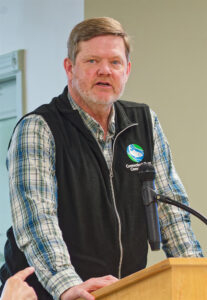
Ron opened his comments with an overview of the Connecticut River watershed
- The Northeast’s largest watershed. You can step over the river its beginning in northern NH where it is about 3 feet wide.
- 410 miles long, 100+ tributaries and ~300 communities.
- CRC was organized in 1952.
- In 1965, Katherine Hepburn called it the “most beautiful, well-landscaped cesspool in the world.”
- Its name comes from the Pequot word “quinetucket” meaning “long tidal river.”
- Connecticut River provides 70% of all the fresh water entering the Long Island Sound.
Four states (NH, VT, MA and CT) are part of the same watershed—“an area of land that drains into a single body of water that then drains into an estuary and bay. Ron is working on projects in Orford, New Hampshire, and Barnard, Vermont, on tributaries that flow into the Connecticut.
Ron began at CRC in 2011; he was just the 10th or 11th staff person, working part-time at an organization with a total budget of $1 million. Today, CRC has 30 staff and a $7 million budget, with most of that growth coming since Ron started there. CRC recently received a grant of $10 million to work with farmers and owners.
KEYS GOALS OF CRC: Clean water, healthy habitats, and resilient communities.
Climate change is changing the stakes for the Connecticut River. We don’t worry only about spring runoff as we did in the old days when the river would rise and then fall. Today, mid-summer storms are causing extensive damage.
These are areas of CRC programs for cleaner, healthier rivers:
- Advocacy & policy
- Aquatic ecology
- Aquatic invasive species
- Community engagement
- Dam removal
- River restoration
- Water quality monitoring
Ron says he often introduces himself like this: “Hi, I’m Ron. I’m addicted to dam removals.” He has removed 25 dams so far and does 1 or 2 a year. Ron said that an 18’ high dam has 17’ of sediment trapped behind it. When he removed a dam in Norwich a couple of years ago, the clean-up required 753 tri-axle dump loads of sediment.
The majority of CRC’s work is collaborative. 200 volunteers take water samples where people use bodies of water for swimming or boating. CRC has 10 years of accumulated data that folks can check on its web site before dipping in their toes. Ron’s advice: if the water is murky/muddy, it could be a little more likely to harbor E. coli.
Recently, the Long Island Sound (into which the Connecticut River empties) got an A-, its highest environmental score ever. It has taken a long time since Hepburn’s 1965 comment to 2026—improving environmental damage can take a long, long time.
Our biggest volunteer event of the year is the “Source to Sea Cleanup.” This is the 30th year for this event, now with more than 2,000 volunteers removing trash from rivers, parks, and communities. All ages, employees of businesses, etc., participate. CRC provides bags, gloves, and t-shirts, the costs of which are covered by business sponsors.
Other volunteer activities CRC couldn’t possibly afford professionals to accomplish:
- Aquatic invasive plant pulls
- Water quality testing
- Migratory fish surveys
- Source to Sea cleanup
- Tree plantings
Learn more here: ctriver.org. There’s no fixed membership fee; anyone who donates is a member. Anyone may sign up for events at ctriver.org/email.
We’ve been working for decades on Hydropower Relicensing.
There are four dams of concern to CRC: Wilder, Bellows Falls, and Vernon in Vermont and Turners Falls in Massachusetts. Licenses are awarded for 30-50 years. We are fiercely advocating for a healthy Connecticut River, safe fish passage, recreation access, and facility improvements.
A non-dammed river has annual ups and downs. Dams raise and lower the river according to how much electricity the owner wants to make, impacting riverbanks above and below the dam.
Wilder’s license still has technically not being issued. We are taking issue with some of the permitted uses. We anticipate legal action, though negotiations are happening, focused on recreational access to the river. By the way: “Do you know what the fish said when it hit the wall? Dam!”
Recent Comments