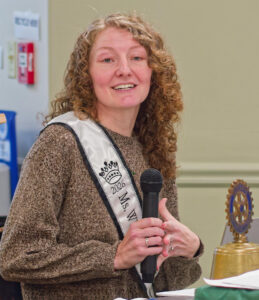
Police officer locally for ten years—Canaan and Hanover. Contracted Long Covid and was recently named Ms. Wheelchair New Hampshire. She experiences brain fog and word search problems, so she delivered her talk with prepared written remarks. Her goal is to expand access to the outdoors to all persons. Husband and two children. Nenia will go to Michigan in August to compete for Ms. Wheelchair America.
It’s not a beauty pageant. Its purpose is to give voice to disabled women, advocate for girls’ rights, accessibility, and inclusion.
Nenia’s first 30-ish years were lived as a fairly healthy and able-bodied individual. She moved to the Upper Valley in her early 20’s and loved it: she hiked, paddled, camped and “farmers-marketed” her way through the area. She worked as a police officer, during which time she developed community events such as the coffee with a cop in Hanover and a Night Out in Canaan.
She came down with Covid; then was diagnosed with disabling Long Covid, which caused her to turn in her badge as the symptoms worsened. Now, Nenia uses a wheelchair to navigate the world not friendly to persons with disabilities.
There are barriers to access—even one or two stairs to a store, a curb in front of an accessible port-a-potty, a paper towel dispenser fastened to a wall above her reach. People wrongly assume that the wheelchair is the issue, that using a WC is a shameful, weak, thing. Abe-bodied persons tend to look down at WC users with pity, making incorrect assumptions about their other abilities. In actuality, the WC and other aids are tools built for independence. Her WC allowed Nenia to be here today. “WC is great for me, but world isn’t prepared for me.”
“Accessible” beach—cannot be one where the sand mat ends 100 feet into the sand.
“Accessible” trail—cannot be one covered in gravel that’s notoriously difficult to manage.
Many spaces labeled “accessible” aren’t really if they are blocked by gates, by mud, rocks, etc. If it’s accessible to you, you might not notice that it isn’t accessible for everyone. This can make one start to distrust “accessible” labels, maybe to the point where one stops going out at all. It takes a lot of energy to get to a place only to find that 6” separates us from using the facility. Wheelchair users are overlooked or forgotten, especially when an easy fix could make a site accessible.
26% of all individuals in the US have a disability. Every day, formerly able-bodied adults join that group.
The key to all this is to start with “Universally designed accessible spaces.” Some argue that making a path accessible will ruin nature. That’s not true! No one is asking to pave over nature. What helps are “accessibility features,” like replacing stone steps, boardwalks, etc., that accommodate and help able-bodied people but not people with mobility disability.
Why does it matter if the outdoor spaces are accessible? First, Nenia says, “Why not make them accessible? How can we justify ignoring a quarter of the population?” Accessibility allows everyone to enjoy the benefits of being outside, exploring nature. Nenia noted, “Being pushed along the Rail Trail would never have replaced my former activity; now, having the tools to access the Trail, I feel freed. But I still feel ‘broken’ when I hit a barrier.”
Accessibility needs to be intentional, part of the why and how of decisions, materials and designs. It needs to be part of the initial and continuing conversations, not added as an afterthought.
“Is it possible to make EVERY outdoor space accessible?”
Not every trail in NH is accessible, even to all able-bodied persons. When we build elements, it makes sense to take access into account. Make the space accessible to as many people as possible. Ex) Create a hard-packed tail with a seamless transition into a boardwalk over a sensitive area. Add guide ropes and braille markers for persons with vision impairment. We have the tools; we just need the world to be designed so we can use them.
Rotary can help. “You have connections with government, not-for-profits, and businesses. Carry this message to your other meetings.”
Nenia thanked Jake’s Market and Deli for making a generous donation to her continuing Ms. Wheelchair campaign, now on the national level. For more information or to donate to help her trip to Michigan: Mswheelchairnewhampshire2026.
Recent Comments