
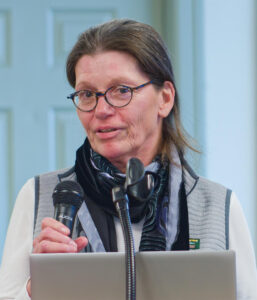
Brooke joined the board in 2010 and has been executive director for the last seven years.
She works closely with Graciela Martinez, executive director of Epilogos in San José Villanueva, El Salvador (SJV). Graciela Martinez has worked with Epilogos for over 20 years. Brooke feels fortunate to be working in an organization committed to working with the people in the community. The organization’s motto is “Everyone is equal.”
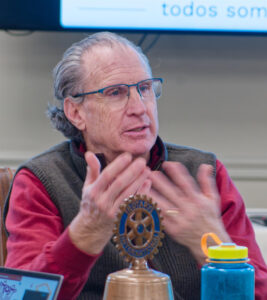
Ignatius is serving his second term as president of the board and has been involved with Epilogos for many years. Ignatius runs the student and adult trips to El Salvador; the next one, February20-26, will be his 25th group, including a student from Lebanon High School, Warren Ramsey. Ignatius leads somewhat less strenuous trips for older adults with more transportation and less physical exertion. Ignatius has ties to the Upper Valley: as a student, he competed in the high jump at the Dartmouth Relays; he helped start the Upper Valley Housing Coalition (and was a colleague and inspiration to Bruce Pacht during Bruce’s six years with Twin Pines Housing).
Epilogos was founded in 2002 by Mike and Susie Jenkins, who met and married while working the Peace Corps in El Salvador; there will be 25th anniversary celebrations next year. The people of San Jose Villanueva understand that Epilogos is there and is staying put.
[From Wikipedia: The population of El Salvador is approximately 6.4 million as of early 2026. It is the smallest and most densely populated country in Central America, with a population density of 308 people per square kilometer. Its land area is slightly smaller than Massachusetts. The population is heavily urban (over 80%) and ranks 113th in the world.
El Salvador is considered a middle-income country with significant poverty and inequality, not a rich nation, though it’s working to improve its economic standing, with some indicators showing progress like increased economic complexity and reduced crime, balanced against ongoing challenges with poverty (around 30% in 2023), vulnerability (40%), high debt, and informal labor. Its clocks operate in the USA Central Time Zone; a direct flight from Boston to the capital, San Salvador, takes about six hours. It has about a 190-mile coastline along the Pacific Ocean.]
Epilogos’s work in El Salvador is in three areas:
- Education;
- Safe homes;
- General community support.
Since 2002, Epilogos has provided scholarships to over 2200 students. In 2026, they gave scholarships to 61 in grades K-9, 63 in high school, and 19 students with special needs.
There are local K-9 schools in surrounding villages that feed the single high school in SJV. Ignatius pointed out that these rural kids with a 9th grade education can get good jobs, for example, in the tourist industry, a call center, or building supplies store. If they can go beyond that in school, they acquire more English, skills, and training. Epilogos has an internship program as well.
The scholarships are to a private Catholic school that anyone may attend. The school offers music, band, art, and English and has significantly smaller class sizes than the elementary schools.
Enrollments are up about 30%, now that the era of gang violence and the Covid pandemic have passed. More kids from outlying schools are safer to travel to SJV than before. The school year funs from February–November. Tuitions are grades K–9 = $195; 7-12 = $245; and special needs = $270. Last year, Lebanon Rotary’s $1,000.00 donation provided tuition for four special needs students.


[Above: The four special needs students that the Rotary Club of Lebanon helped support this year.
Here are translations of their parents’ remarks for each of the four students:
- “My daughter has learned to socialize and develop her skills this year with great progress. May God Almighty bless this excellent gesture of gratitude towards our children.”
- “Leonel is attending 6th grade this year with his classmates and shows and expresses that he is happy playing and learning, but he also attends the support classroom to receive help with his language and tasks that he finds difficult.”
- “We are very grateful to the foundation for providing tutoring for our son. We have truly seen tremendous progress in his education; he pays much better attention to instructions and is more cooperative with craft activities.”
- “I want to thank the Lebanon NH Rotary Club for their support and trust in us, giving us their help. Their help is very important because thanks to them, we can send my daughter to learn. My daughter has been able to interact with other children, which fills her with joy. She loves to paint, and it has been her way of learning this year. May God reward you for all your good deeds.”

Some students also need lunch assistance, uniform assistance, etc., beyond tuition. Epilogos requires that students participate in Epilogos programs and keep their grades up. Parents must also volunteer to support their children.
This year, there are now 19 students in the special needs programs, and Epilogos has hired a fulltime teacher: “Karen” got her education degree in 2025. Students attend one AM and one PM academic sessions each day. With students in class, mothers also have some time to flourish. Epilogos pays for the teacher and materials. Epilogos also supports six students in college.
Earlier graduates have gone into teaching, law, nursing, computer hardware technology, and other fields. “Melvin” graduated from tech college and now works servicing and repairing computers and printers.
Ignatius said that he and his wife have sponsored one student for the past six years; this student will become an engineer, though her family has lived in SJV without water or sewer. She will graduate in November; her work in the state highway dept will allow her to help her family.
“Adopt a Classroom Program”: Epilogos has adopted 46 rooms for provision of classroom supplies.
“Big Friend Little Friend”: A mentorship program bringing together HS and elementary students. Participants gain self-confidence, self-esteem, and motivation while meeting bi-weekly.
“Casa Dignas” (“decent homes”): In a typical year Epilogos builds two to four houses; this February, they plan to build two. Materials for a 440 square-foot cinder block house cost $8,000.00; these shelters change people’s lives. Those who live in the houses pay a fee each year that goes to purchase materials for the next home—labor is all free. It’s a big change for a family to be able to be dry during rainy season, and to have a locked location where their possessions will be safe when they leave for work. People who live in SJV work hard, maybe making $10-12/day. It’s a structural economic problem that keeps them from accumulating wealth; it’s not a problem of not working hard enough.
Since 2002, volunteers have helped build 92 houses and have partnered on 150 more. Volunteers work alongside family members and tradespeople. Visiting groups stay at a retreat center about 20 minutes away from SJV. Groups visit the capital, San Salvador, to experience the culture and history of El Salvador. The one-week trips are truly an immersive experience. We celebrate with a barbecue each year at one of the houses. We do a lot of walking.
Epilogos also provides community support for a robotics program, soccer uniforms, new desks for classrooms, community gatherings in outlying villages, and more. The organization partners with various Rotary groups and church groups. Eye Care International made a big trip to SJV last January. Epilogos also has connections with Engineers Without Borders, the Peace Corps (which has just returned to El Salvado after years of gang violence ebbed), and Habitat for Humanity.
The organization takes accountability very seriously. El Salvador’s government has just imposed a 30% tax on NGOs working in the country, but Epilogos has gotten an exemption, partly because of its work to make sure the financial end of things are legitimate.
Epilogos has some potential long-term projects that we might work on together in the future:
- Courtyard roof—to fight heat and rain;
- One outlying school needs a perimeter wall to keep people from coming on to the grounds for non-school reasons.
Recent Comments