
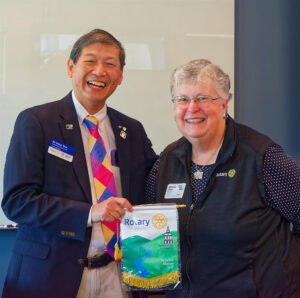
Our speaker was Victor Tom and his wife Sze-Wen.

Dr. Victor Tom (MIT class of ’72) received his BS, MS, and ScD, all from the Electrical Engineering and Computer Science Department at MIT. He has worked at a number of defense companies and MIT startups. He is a third generation Rotarian, Past President of the Rotary Club of Bedford, Past District Governor of District 7910 (Central MA and MetroWest Boston) and advisor to the MIT Rotaract Club.

Sze-Wen Kuo (MIT class of ’73) received her BS in mathematics at MIT and her MS from SUNY (State University of NY) at Stony Brook. She has worked at a number of software companies, specializing in compilers and operating systems such as ADA. Sze-Wen has received the Bronze Beaver, the highest award that MIT can give to volunteers. Sze-Wen is also a Past President of the Rotary Club of Bedford and past District 7910 secretary.
Dr. Tom and his wife are actively involved in supporting the MIT PKG IDEAS Social Innovation Challenge by assisting students refine innovative projects designed to help underserved populations around the world. They have also recently endowed a Rotary scholarship to fund masters’ degree candidates in the MIT DEDP (Data, Economics, & Design of Policy) to fight poverty in underdeveloped countries. They are also building a network of MIT alumni Rotarians to help fund humanitarian projects at and originating from MIT in the seven Rotary focus areas. Together they are members of Paul Harris Society, Major Donors, Arch Klump Society, and the Bequest Society.
“How Rocket Science made its way into Major League Baseball
and the Strike Zone”
Victor Tom had a long career in electrical engineering and computer science at MIT. He also worked for a number of defense companies and MIT startups, and he is currently chief scientist at BAE systems in Burlington, Massachusetts.
Victor Tom help the US team win the 1992 America’s Cup trophy by mapping the wind through its effects on the ocean surface, so that the American team had a huge advantage over its opposition. In 1999, QuesTec started research on computer calling strikes and balls in baseball games. Victor Tom heard of this effort, got in touch with QuesTec and reviewed what they were doing. He almost immediately began thinking that he could do a much better job. So, he started the research and brought it to Fenway Park for a demonstration of what he came up with in opposition to QuesTec. This was in August 2000, and he got the contract.
He devised the system where two cameras placed as high up as possible in the right field stands and the left field stands would focus on home plate. In addition, there was a camera behind the back stop and a camera in the outfield. With those cameras in place, he could use the computer program he developed, together with these cameras, to accurately call balls and strikes.
In 2001, Victor developed an “umpire informational system,” funded by major league baseball and accurate to one-half inch. Sandy Alderson used UIS to grade the umpires. The umpire’s union sued everybody—major league baseball, Victor Tom, and the company that Victor Tom founded—because they didn’t like being graded and having their income affected as a result. The umpire’s union hired an expert from Yale. It turned out that this move was a mistake because the expert from Yale, after examining the umpire informational system, came to the conclusion that the system was amazingly accurate.
Victor Tom got a pair of tickets to all playoff games in the World Series from Sandy Alderson and was in the stands when the Red Sox finally broke the curse of Babe Ruth.
The latest development for Victor Tom’s system occurred this past spring. The system developed by him to this point had only been used for television viewing; major-league baseball, in fact, did not use it to call balls and strikes. In spring training this year, however, it was implemented; and the way it was used was to allow each team two challenges to be tested by the system in preseason. That is, in each game any player or manager for a given team could challenge a call made by the umpire, and if the computer driven system said the umpire was wrong then the call was corrected.
Recent Comments