
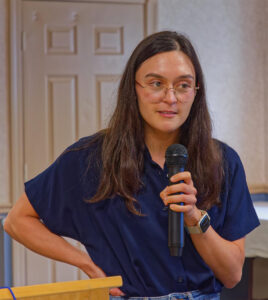
Lynée Turek-Hankins, post-doctoral program in engineering and earth sciences at Dartmouth College.
Dr. Turek-Hankins studies equitable climate-change adaptation and mitigation for the interconnected housing and energy sectors.
The types of questions raised by climate risk management are:
- How do we deal with greenhouse gases?
- How high should we build a seawall?
- How do we manage forests for wildfires?
In her talk to the club, Lynée presented an overview of a class that could be entitled “Climate Science 101.” She used a number of slides illustrating the interpolated changes of the earth’s temperature over hundreds of thousands of years and the documented changes in the earth’s temperature since 1850 and the Industrial Revolution. Both analyses firmly establish as fact that human activity is the cause for our present experience of climate change.
The evidence is conclusive that CO2 gases warm the planet. As CO2 warms the planet, the buildup of its presence in the environment results in a “stock” problem, wherein it takes much more time to dissipate the carbon gas (with a half-life of 150 years) than it took to introduce it into the environment in the first place. Warming is fast; cooling is slow.
How can we manage these greenhouse gases?
- Mitigation—reduce the flow of greenhouse gas into the air (EV cars, etc.)
- Carbon sequestration—reduce the stock of greenhouse gas by taking the CO2 out of the air.
- Solar radiation management—controversial and hypothetical countervailing techniques such as placing solar mirrors in orbit to reflect heat back into space.
- Adaptation—plant trees, insulate housing, etc.

Recent Comments