
Our speaker today was Bob Lyon, PhD, did his undergraduate work in Biology at Fairfield University in Fairfield, CT and his graduate (PhD) work at the Albany Medical College in Albany, NY. Bob’s graduate and post-doctoral focus was the receptor pharmacology of brain active molecules including drugs of abuse. Bob’s professional career was spent at the Procter and Gamble Company in Cincinnati, OH with leadership roles in Drug Research and Development, Global Clinical Trials, FDA Interactions and Business
Development. Bob has given courses and talks on Drugs of Abuse both locally and as an invited speaker. Bob retired and moved to New London with wife JoAnn in 2019. Bob has published 36 scientific papers in peer reviewed journals as well as a book chapter.
We learned he is a talented badminton player, especially when paired with David Crandall.
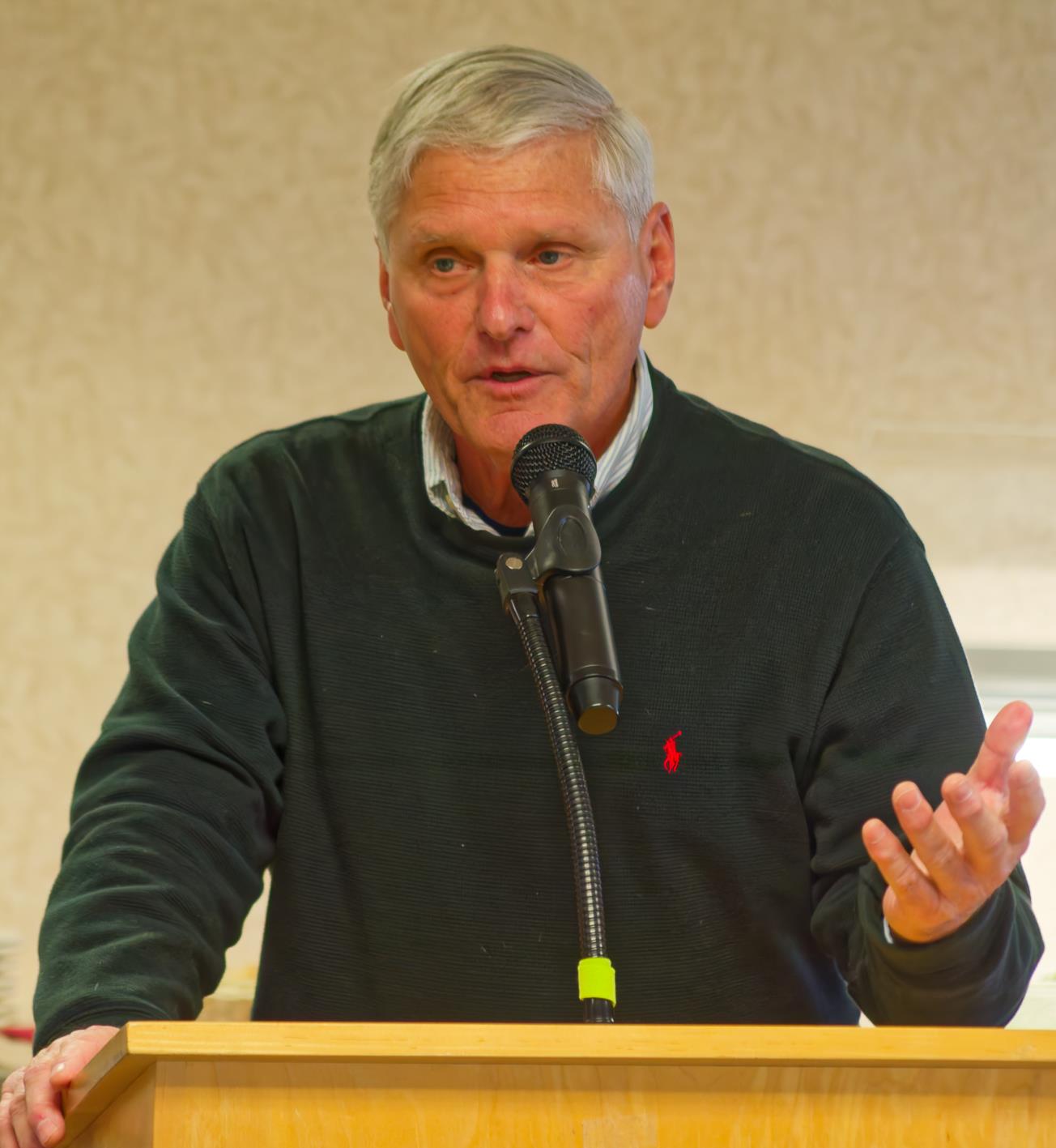
Bob Lyons
Lyon’s first slide showed us the chemical structure of the Caraboid that gets you high when marijuana is ingested or smoked.

He then reviewed some basic information about marijuana plant:
- Marijuana is a plant containing ~ 100 cannabinoids
- Delta 9 THC is the primary psychoactive cannabinoid
- Marijuana use for thousands of years: “recreation/medical”
- Marijuana remains a Schedule 1 Drug at Federal level; this complicates how the plant is managed within states. Many banks do not want to do business with cannabis retailers. Businesses not eligible to small business federal loans.
- It isn’t clear what the exact properties of the remaining cannabinoids is. There is no incentives for drug companies to investigate this plant moro thoroughly.
- Recreational Marijuana Legal in 24 States + DC
- Medical Marijuana Legal in 39 States + DC
- Maine, Vermont, Massachusetts and Connecticut: Legal
- In NH it is only approved for Medical uses.
- Marijuana is classified as Schedule 1 Drug at Federal Level
- New Hampshire “Approved” Uses: Stand Alone and Qualifying
- Stand-Alone Conditions: Autism, Anxiety, PTSD, Chronic Pain, Severe Pain, Opioid Use Disorder
- Qualifying Conditions: Alzheimer’s, Cancer, Crohn’s, Pancreatitis, Epilepsy, Glaucoma, Lupus, MS, MD, Parkinsons, Ulcerative Colitis (among others)
- Qualifying Symptoms Include: nausea, vomiting, pain, muscle spasm, wasting, seizures, insomnia (among others)
There is one FDA approved use for THC (Tetrahydrocannabinol). THC is approved for emesis and appetite stimulation, by prescription only. It is called Marinol and Epidiolex
Marijuana has become more potent over the years. If you consumed marijuana back in the 70s and 80s, beware that marijuana is much stronger…so beware if you want to try it again now.
- 1970’s:
- 2-3% THC content
- Typically smoked a few joints or a full bowl
- Now:
- 25% THC content common, some strains higher
- Typically smoke 1-2 “hits”
There is one type of Marijuana called Dabs that contain up to 90% THC!!
Certainly not the marijuana of our speakers youth.
Lyons reviewed the use of Marijuana for pain.
- Limited clinical data to support its use
- Few randomized, controlled clinical trials
- Trials tend to be small in number
- Trials run differently
- Studies to support FDA approval non-existent
- THC, the only approved cannabinoid, (Marinol) not effective in pain studies
- If effective marijuana does help, it may be due to one of the other100 cannabinoids in the marijuana plant.
- He used a graphic example of traumatic pain to illustrate that marijuana cannot replace opioids.
Marijuana’s safety profile is complicated.
- Things to Keep in Mind:
- Occasional vs. Chronic use. Chronic use can lead to cannabis use disorder, which takes the form of addiction in severe cases. Recent data suggest that 30 percent of those who use marijuana may have some degree of marijuana use disorder.
- Some will develop Cannabinoid Hyperemesis Syndrome. He noted that this syndrome which causes abdominal pain can be relieved with a hot shower. If syndrome will go away if the person stops using marijuana. It can be hard to diagnose is the patient doesn’t share their cannabis history.
- Age of user: Brain not fully developed until about age 21 (or longer). This can cause developmental issues over time.
- Individual differences in addiction/dependence potential
- Delta 9-THC Content of marijuana strains: Big Change!!
Lyon concluded his remarks by reminding us that cannabis may not be the demon drug from “Reefer Madness,” but neither is it a wonder–plant with limitless upsides and no downsides.
Recent Comments