
Our speaker today was Rotary Foundation Scholar Grace Gray
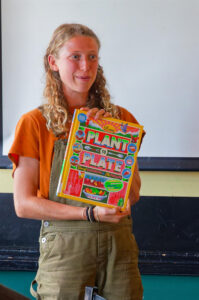
Rotary Foundation Global Scholar Grace Gray. Grace attended the university of Virginia as a Jefferson and Eccles scholar studying environmental thought and practice and global development studies. She graduated in 2024. In January 2026, thanks to the Encouragement of President Marilyn and the generosity of Rotary District 7850 and Rotary international. Grace was awarded a global scholarship to attend the American University of Rome, where she will study for a masters in sustainable food studies. 
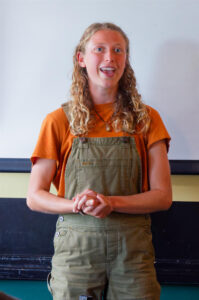
Grace, an articulate and enthusiastic speaker, started off by telling us that she is one of ten siblings and that when she was eight years old, she had to assume responsibility for getting food on the table for her younger brothers and sisters. She told us that she focused on apples, carrots, and peanut butter—what she then considered a balanced diet. What she found rewarding about this responsibility was the opportunity to make meals filling and enjoyable and to take dinner time as a window to open up conversations—not only with her siblings, but also with a variety of people that she interacted with. Grace was impressed by food and its ability to bind people.
When Grace goes to Rome, she will be studying food, access, and policies for a year and a half. She would like to work for food to become recognized as a human right.When grace was fourteen years old, she fell in love with New England as a result of applying virtually on her own for admission to Phillips Exeter Academy. When she was admitted, it was the first time in her life that she wasn’t very concerned with food anxiety.

Grace works at an organic farm in Jericho, Vermont, and lives at a different farm, also organic, also in Jericho. She is very concerned with farm viability and security, not only in Vermont small farms, but with a larger focus as well. Small-scale farmers are struggling in Vermont and often have outside jobs to supplement their income. In Vermont there is a lot of emphasis on locally grown agricultural products and Grace would like to work to make locally grown products the cheapest food in the supermarket.Before coming to New England, Grace was not acquainted with organic food. She thought of it as not for people like her family, but for “the other.” But given her studies and the work she has pursued, she is convinced of the benefits and the necessity of eating organic. Since she graduated from college, Grace has worked on farm issues with a variety of shareholders: small farmers, legislators, and others that she believes can influence policy.
After she obtains her master’s degree, she wants to bring her studies back to New England and concentrate on food, policies, and issues. When ask about what effect the severe drought in Vermont and New Hampshire had on farming, she told us that the effects are less dramatic than the worst storms in Vermont history and are more of a slow burn. Because scarce water affects the sugars that crops produce, there aren’t necessarily fewer crops to harvest, but there are much less nutritious crops. It really is a mixed bag on which crops do well or not in any particular area of Vermont.
When Grace goes to Rome, she will be studying food, access, and policies for a year and a half. She would like to work for food to become recognized as a human right.When grace was fourteen years old, she fell in love with New England as a result of applying virtually on her own for admission to Phillips Exeter Academy. When she was admitted, it was the first time in her life that she wasn’t very concerned with food anxiety.
Grace works at an organic farm in Jericho, Vermont, and lives at a different farm, also organic, also in Jericho. She is very concerned with farm viability and security, not only in Vermont small farms, but with a larger focus as well. Small-scale farmers are struggling in Vermont and often have outside jobs to supplement their income. In Vermont there is a lot of emphasis on locally grown agricultural products and Grace would like to work to make locally grown products the cheapest food in the supermarket.Before coming to New England, Grace was not acquainted with organic food. She thought of it as not for people like her family, but for “the other.” But given her studies and the work she has pursued, she is convinced of the benefits and the necessity of eating organic. Since she graduated from college, Grace has worked on farm issues with a variety of shareholders: small farmers, legislators, and others that she believes can influence policy.
After she obtains her master’s degree, she wants to bring her studies back to New England and concentrate on food, policies, and issues. When ask about what effect the severe drought in Vermont and New Hampshire had on farming, she told us that the effects are less dramatic than the worst storms in Vermont history and are more of a slow burn. Because scarce water affects the sugars that crops produce, there aren’t necessarily fewer crops to harvest, but there are much less nutritious crops. It really is a mixed bag on which crops do well or not in any particular area of Vermont.
Grace was asked about the effect that climate change has on a farming and she very bluntly said, “We need to wake up.” Climate change is making agriculture more unstable in the last three years as we have had two years that had 110-year storms and this year we are experiencing extreme drought. Grace observed that food instability caused by climate change has been a factor in wars and a factor in movement of peoples.
Recent Comments